Electrical & Electronics Interview Questions & Answers
Basic Electrical & Electronics Engineering and Technology Interview Questions & Answers
- Why Transformer Rated In kVA, Not in KW?
- Why Motor rated in kW instead of kVA?
- Why AC (Air-condition) rating in Ton, not kW or kVA?
- Why Alternator rated in kVa, not in kW?
- Why Battery rated in Ah and not in VA?
- Why Power Plant Capacity Rated in MW and not in MVA?
- Why we can’t store AC in Batteries instead of DC?
- Why Earth Pin is Thicker and Longer in a 3-Pin Plug?
- What are the Colored Aerial Marker Balls on Power Lines For?
- Why Electric Power Transmission is Multiple of 11 i.e 11kV, 22kV, 66kV etc?
- Which Bulb Glows Brighter When Connected in Series and Parallel & Why?
- Is Lightning AC or DC ?
- Why Transformer Does not Work on DC Supply instead of AC?
- What Happens When an AC Line Touches a DC Line?
- Why Do Electronic Circuits Use DC Current instead of AC?
- How to Design, Calculate and Install a Solar Panel Energy System
- Three Phase Induction Motors (MCQs with Explanatory Answers)
- Batteries. (MCQs with Explanatory Answers)
- How to find The value of Burnt Resistor ( By three handy Methods )
- Capacitors (MCQs with Explanatory Answers)
- How to Calculate/Find the value of Ceramic / Non-Polarized Capacitors?
- Why Power is Zero (0), in Pure Inductive, Pure Capacitive or a circuit in which Current and Voltage are 90 Degree out of phase?
- Basic Concepts (MCQs With Explanatory Answers)
- DC Circuits (MCQs with Explanatory Answers.)
- Alternator / Generator ( MCQs with Explanatory Answers)
- Transformer (MCQs With Explanatory Answers)
- Single Phase AC Circuits. MCQs ( With Explanatory Answers)
- Why Current Decreases When Inductance or Inductive Reactance Increases?
- Why Current Increases When Capacitance Increases or Capacitive Reactance Decreases?
- In an Inductive Circuit, Why the Current Increases When Frequency Decreases?
- In a Capacitive Circuit, Why the Current Increases When Frequency Increases?
- Why Power Factor Decreases When Inductance or Inductive Reactance Increases?
- Why Power Factor Decreases When Capacitive Reactance Increases or Capacitance Decreases?
- Three Phase AC Circuits (MCQs With Explanatory Answers)
- Easy Charging Time and Charging Current Formula for Batteries. ( with Example of 120Ah Battery).
- How To remember the direction of PNP and NPN Transistor. One of the Easiest way.
- What is the Rule of Capacitor in AC and DC Circuit?
- Batteries Configuration. These Batteries have Connected in series or parallel? Clear Your Concept.
- A Bulb is Connected in this strange way with Ammeter as shown in fig. then what will be the current in Amp-Meter? (Clear Your Concept)
- Clear Your Concept. What will be the Current In ampere-meter which connected in Short path in This Basic Circuit.?
- Clear Your Concept. What will be the Current In ampere-meter in This Basic Circuit.?
- Ampere meter is connected in series with load. if there is also a short path, what will be the current in Amp-Meter?
- What is the normal or average life expectancy of a Transformer ?
- Why Flux in Primary and Secondary Winding of the Transformer is Same?
- According to Ohm’s Law, Current increases, when Voltage increases,(I=V/R), But Current decreases, when Voltage increases according to (P=VI). Explain?
- Why A.C needs more insulation than D.C at same voltage level?
- What is the objection to have lamps in a house-lighting circuit connected in series?
- How To Find/Calculate the Number of Fluorescent Lamps in a Sub Circuit?
- How to Determine the Number of Lamps in Final Sub Circuit?
- How much Watts Solar Panel We need for our Home Electrical appliances?
- Will a D.C Shunt Motor operate on an A.C Supply?
- Why the Reactance & Voltage under Fault Condition is Low and Current is High?
- Why Volume of the Conductor is Inversely Proportional to the Square of Voltage?
- AC Voltage at Home is 230V but its Equation is v = Vm Sin θ. Explain?
- What is the purpose of ground wires in over-Head Transmission lines?
- How To Calculate Your Electricity Bill. Easy and simple Explanation.
- A step up transformer which has 110/220 turns. Can we replace it with 10/20 turns? Turns ratio is same shall its rating be same? Give appropriate reason?
- Is it Possible to Operate a 50Hz Transformer on 5Hz or 500Hz Frequency?
- What will happen if the primary of a transformer is connected to D.C supply?
- Why We Need to Install a Starter with a Motor?
- Why an Inductor acts as a Short Circuit in DC Supply?
- What is motor starter?
- How to calculate the value of resistor for LED’s (with different types of LED’s circuits)
- How to Calculate/Find the Rating of Transformer in kVA (Single Phase and Three Phase)?
- How to Test a Capacitor by Digital & Analog Multimeter – 6 Methods
- What is the Q Factor in Electrical and Electronics Engineering
- How to Install a Solar Panel?
- Power Factor improvement Methods with Their advantages & Disadvantages
- Causes of Low power Factor
- Advantages of Power factor improvement and Correction:
- Working and Construction of Electric Phase or Line Tester
- How to find Diversity Factor in Electrical Wiring Installation
- Series, Parallel and Series-Parallel Configuration of Batteries
- How to Connect a Portable Generator to Home Supply System (Three Methods)
- Norton’s Theorem. Easy Step by Step Procedure with Example (Pictorial Views)
- Thevenin’s Theorem. Easy Step by Step Procedure with Example (Pictorial Views)
- How to determine the number of Nodes, Branches, Loops and Meshes in a Circuit?
- A Voltmeter, Ampere Meter and a Battery Cell are connected in Series. It is Observed that Ammeter Practically Shows No Deflection. Why?
- How to calculate or Find the value of SMD Resistors
- How to determine the suitable size of cable for Electrical Wiring Installation with Solved Examples
- How to Calculate the Suitable Capacitor Size in Farads & kVAR for Power factor Improvement.
- How to Convert Capacitor Farads into kVAR and Vice Versa (For Power factor improvement)
- Can We Operate a 60Hz Transformer on 50Hz Supply Source and Vice Versa?
- Which Transformer is More Efficient When Operates on 50Hz or 60Hz?
- Why Does A Capacitor Block DC But Pass AC?
Comparison & Differences
- Difference Between MCB, MCCB, ELCB & RCB, RCD or RCCB Circuit Breakers
- Difference Between Active and Reactive Power
- Difference between Analog and Digital Multimeter
- Difference Between Capacitor and Supercapacitor
- Difference Between a Battery and a Capacitor
- Difference between Circuit Breaker and Isolator / Disconnector
- Difference between Fuse and Circuit Breaker
- Difference between Contactor and Starter?
- Difference Between Relay and Circuit Breaker
- Difference between Power Transformers and Distribution Transformers?
- Difference between Star and Delta Connections – Comparison Of Y/Δ
- Difference between AC and DC Resistance & How to calculate it?
- Difference Between Electrical and Electronic Engineering?
- Difference between Active and passive Components ?
- Difference between Linear and Nonlinear Circuit?
- Difference between Real Ground and Virtual Ground?
- Difference between Unilateral and Bi-Lateral Circuits & Elements?
- Difference between a VOLTAMETER and a VOLTMETER?
- Differences between E.M.F and Voltage (P.d)?
- Difference Between Neutral, Ground and Earth?
- Difference Between Conductor, Semiconductor and Insulator
- Difference Between Conductor and Superconductor
- Difference Between a Transformer and an Induction Motor
For latest and more recent Electrical & Electronics Interview Questions & Answers , Click here.Thanks
Related EE Engineering Questions / Answers
- Basic Electronics Engineering Interview Questions & Answers
- Basic Electrical Engineering Interview Questions & Answers
Related Articles
-
 What is the Power Angle in a Power Transmission Line?
-
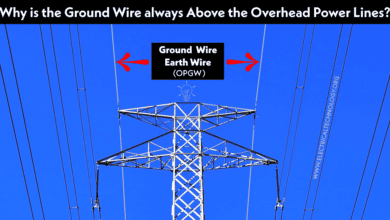 Why is the Ground Wire Always Positioned Above the Overhead Power Lines?
-
 What is the Minimum Ground Clearance for Overhead Power Line?
-
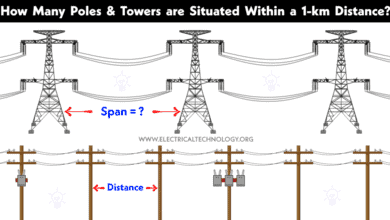 How Many Poles and Towers are Situated Within a 1-km Span?
-
 Why are Overhead Power Transmission Lines Not Insulated?
-
 Why are “High Voltage” Signs used when Only Current Kills?